

Press Release
KAID Holds 2026 Fall Scientific Meeting in Busan Under the Theme “K-Implant for Global Standardization!”
Content
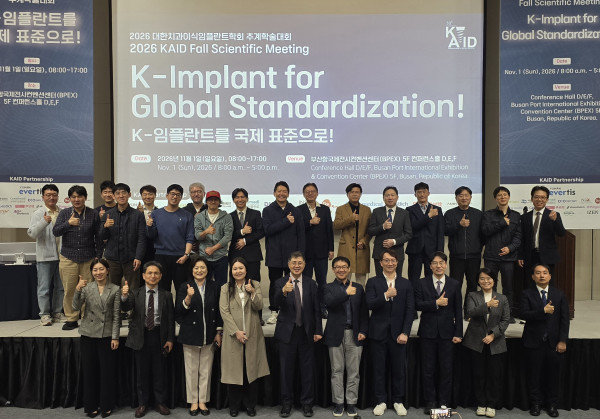
BUSAN, Republic of Korea
— The Korean Academy of Implant Dentistry (KAID) held its 2026 Fall Scientific Meeting in Busan, the birthplace of Korea’s dental implant industry. Under the theme “K-Implant for Global Standardization!”, the meeting explored how Korean advances in implant technology, clinical practice, education, and research can contribute to international standards.
The meeting drew approximately 200 participants, including about 120 advance registrants, 20 on-site registrants, and dental hygienists who attended through complimentary registration. Speakers from Korea and abroad shared recent advances and practical insights on topics ranging from guided bone regeneration and maxillary sinus augmentation to digital workflows, anterior esthetics, insurance claims, and patient consultation.
Advancing K-Implant Toward Global Standards
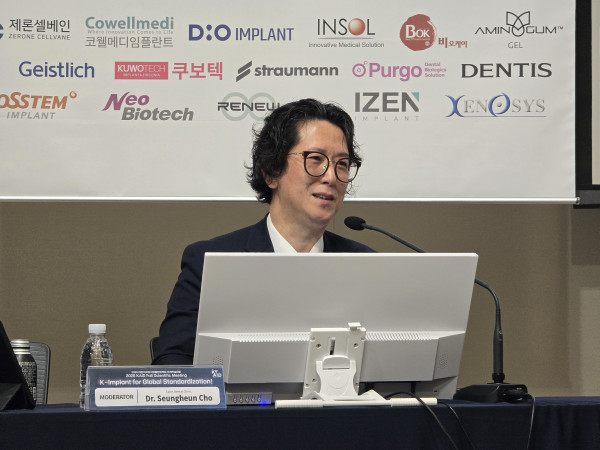
In his welcome address, Organizing Committee Chair SeungHeun Cho emphasized KAID’s commitment to scientific research, professional ethics, and, above all, the preservation of human life and dignity. He noted the significance of holding the meeting in Busan, where Korea’s dental implant industry began.
Cho thanked those whose dedication and innovation have contributed to the success of K-Implant. He called for continued collaboration to advance Korean implant dentistry and establish K-Implant as a global standard of excellence across implant technology, clinical care, education, and research.
Scientific Program Highlights
Sessions in Conference Halls D and F covered foundational implant procedures, complex reconstruction, digital dentistry, soft-tissue management, and professional development for dental teams.
Conference Hall D — Clinical Techniques, Digital Workflows, and Esthetics
Graft Stability and Guided Bone Regeneration — Dr. YoungJae Baek (Nulpurun Dental Clinic, Yangsan) discussed mechanical stability and tension-free primary closure in guided bone regeneration (GBR), including the use of platelet-rich plasma (PRP), platelet-rich fibrin (PRF), and membrane fixation techniques.
Maxillary Sinus Augmentation and Early Loading — Dr. JaeSeok Kang (Yedam Dental Hospital) presented a simplified sinus augmentation approach using aggressive thread design and bicortical fixation. He discussed how the approach can reduce reliance on bone grafting and enable early loading at three to four months in selected cases.
Digital Workflows for Complex Cases — Dr. YoungKu Heo (Dr. Heo Dental Clinic) demonstrated a streamlined digital workflow that enables immediate chairside delivery of a 3D-printed provisional prosthesis in challenging cases, including fully edentulous arches and severe alveolar bone resorption.
Narrow Alveolar Ridges and Multi-Level Implants — Dr. Cheol-Woong Jeong (Cheomdan Mir Dental Hospota;, Gwangju) presented The 5 to 5 Concept, which emphasizes preservation of residual bone, and introduced SSML, a scan-based, model-less full-arch digital workflow.
New KS Implant Lineup — Dr. KiSeong Kim (Namsang Dental Clinic) introduced Osstem’s New KS Implant lineup and its B, T, and S platforms, discussing their clinical applications in immediate placement and loading.
Anterior Esthetics and Soft-Tissue Management — Dr. MyungHwan Ahn (AM Dental Clinic) presented guidelines for three-dimensional implant positioning to balance white and pink esthetics, as assessed by the White Esthetic Score (WES) and Pink Esthetic Score (PES). Dr. Keun-Yong Lee (Cham Dental Clinic) explained when, why, and how to use connective tissue grafts (CTG) and free gingival grafts (FGG) for soft-tissue augmentation.
Full-Arch Rehabilitation and Occlusion — Dr. JinSu Lim (Suncheon Mir Dental Clinic) presented a digital diagnostic wax-up workflow for full-arch implant rehabilitation. Dr. Joong-Hyuk Woo (With Dental Clinic) reviewed principles from conventional denture prosthodontics and orthodontics that inform occlusal design for implant-supported prostheses in edentulous patients.
Conference Hall F — Sedation, Complex Oral Surgery, and Dental Team Development
Introducing Sedation into Implant Practice — Dr. SeungHyun Lee (Saem Dental Clinic) discussed preoperative assessment, the properties of sedatives such as midazolam and remimazolam, and emergency management. The session addressed how sedation can help manage dental anxiety and expand treatment options for appropriately selected patients.
Reconstruction in Complex Oral and Maxillofacial Cases — Prof. HyunJe Kim (The Catholic University of Korea, Incheon St. Mary’s Hospital) discussed surgical approaches to medication-related osteonecrosis of the jaw (MRONJ), previously irradiated jawbone, and defects following benign tumor resection. He considered the roles of bone perfusion and the local immune environment, including macrophage M1/M2 polarization.
Short Implants and Biomechanics — Dr. Yong-Kwon Lee (Cheongju Seoul Good Dental Hospital) discussed biomechanical considerations for using implants 8 mm or shorter and 5.0 mm or wider in anatomically constrained sites.
Dental Team Development and Practice Management — SunA Hong (Dentalier) covered insurance claims for implant treatment. DoYeon Kim (Dental Wiki Company) presented ways to standardize electronic medical record (EMR) charting and improve practice workflows. JiHye Jeon (Centum Heart Dental Clinic) spoke about building patient trust during consultations and how that trust can lead to patient referrals. The sessions were well received by dental hygienists and other members of the dental team.
Research Presentations and Awards
Researchers and clinicians from across Korea presented original work in the oral and poster sessions. Participants included a team from Seoul National University Dental Hospital led by Prof. Soung Min Kim. Presentations covered alveolar ridge augmentation, subperiosteal tunneling, implant apicoectomy, and a possible association between oral galvanism and malignancies around dental implants.
During the closing ceremony, KAID recognized outstanding oral and poster presentations. Dr. Yong-Kwon Lee received the Grand Prize for Oral Presentation for a case of full-arch rehabilitation in a patient with a history of cleft palate surgery.
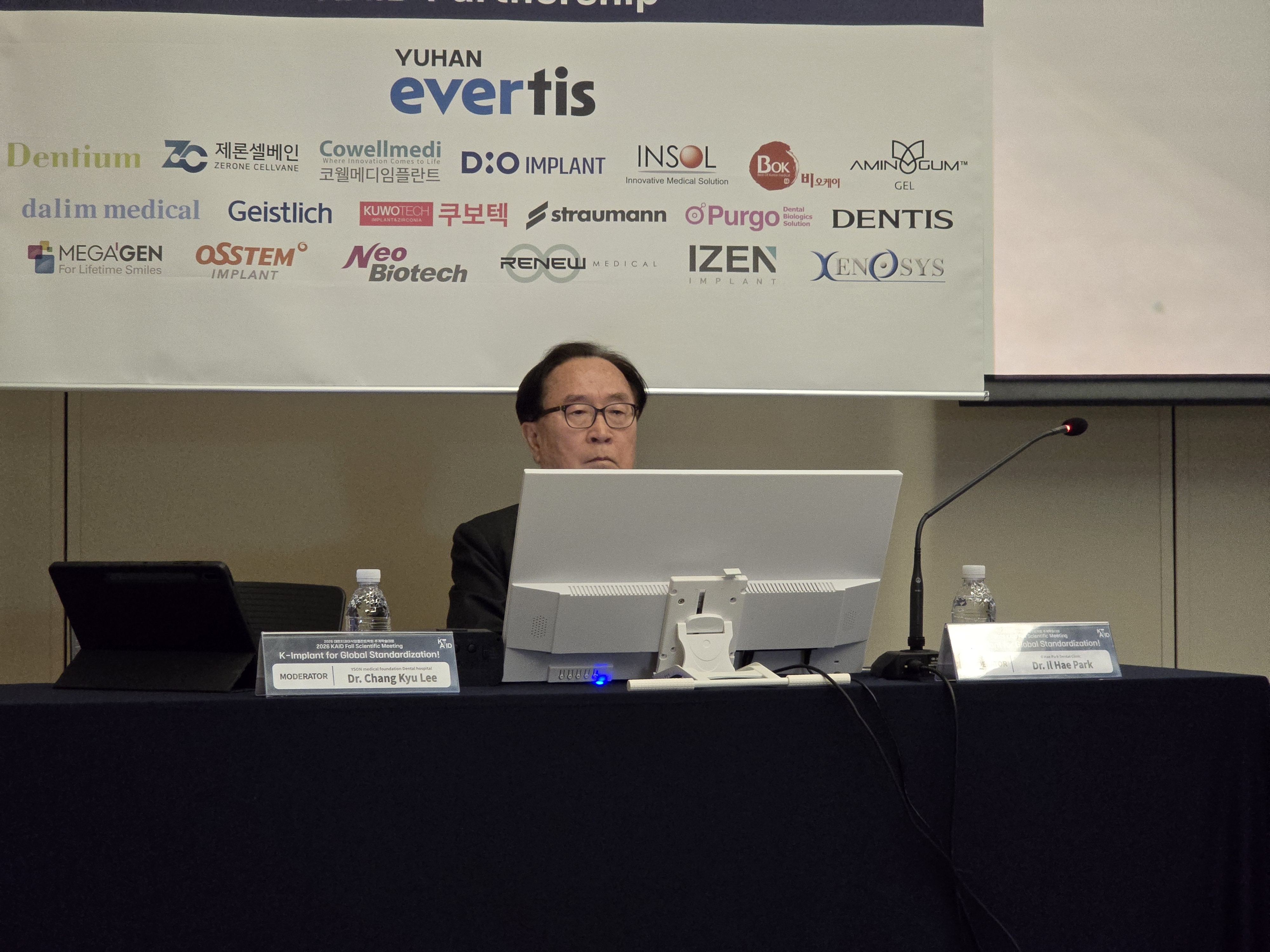
Remarks from KAID Emeritus former President Il-Hae Park
“The drive to restore chewing function, oral sensation, and speech as soon as possible for patients who have lost their teeth is helping accelerate the adoption of digital technologies, including intraoral scanning,” said KAID Emeritus former President Il-Hae Park. “We saw exceptionally talented speakers in Busan, and the quality of their presentations showed how much potential there is for further progress.”
“KAID aims to provide a platform where scientific exchange comes first, diverse views are heard, and decisions are made openly. This meeting laid the groundwork for closer collaboration among dentists, dental hygienists, and dental technicians as we work toward global standards for implant treatment concepts and technologies.”
“We will continue to support speakers who can teach systematic approaches to clinical care and explore ways to offer continuing education through an online learning platform. I also encourage our members to follow and take part in the upcoming election for KAID’s next president.”
Following the meeting, speakers expressed appreciation for the opportunity to contribute to a program grounded in current clinical practice and to learn how their colleagues use digital workflows. They also expressed interest in seeing more opportunities for this kind of exchange.
Building on the Busan meeting, KAID will continue to strengthen the scientific and educational foundations for K-Implant to contribute to global standards in implant dentistry.