

Academic Reference Room
Jeong-Kui Ku Academic Committee – Oral Surgery Division (Peri-implant biofilm revealed by biofluorescence imaging)
Content
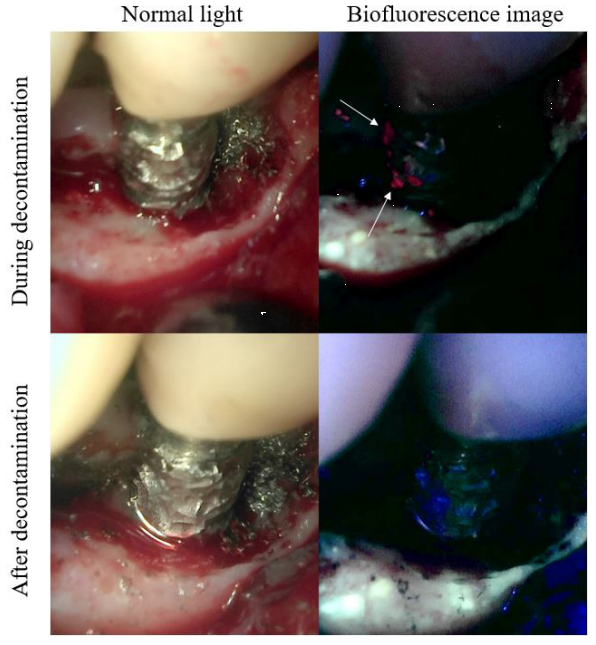
■ Clinical Background and Objective
Peri-implantitis is a biofilm-associated inflammatory disease, and thorough implant surface decontamination is essential for effective treatment. However, residual biofilm may be difficult to identify through conventional white-light inspection. This Clinical Image demonstrates the use of a biofluorescence imaging system (BIS) to visualize implant-associated biofilm that is not readily detectable under conventional illumination and to guide surface decontamination.
■ Imaging Findings and Clinical Application
Using BIS (Qraypen C; AIOBIO) with 405-nm blue-light excitation, red fluorescent signals were identified on the exposed implant surface despite the absence of distinct deposits under white-light illumination. These signals are associated with bacterial metabolic products, particularly porphyrin derivatives, and may indicate the presence of mature oral biofilm. Following additional debridement, the red fluorescence was no longer detectable, visually demonstrating the potential of BIS-guided implant surface decontamination.
■ Clinical Significance
BIS may serve as an intraoperative adjunct for identifying otherwise inconspicuous areas of implant surface contamination and guiding targeted decontamination. However, fluorescence is a surrogate indicator rather than definitive microbiological confirmation and should therefore be interpreted in conjunction with clinical findings.